

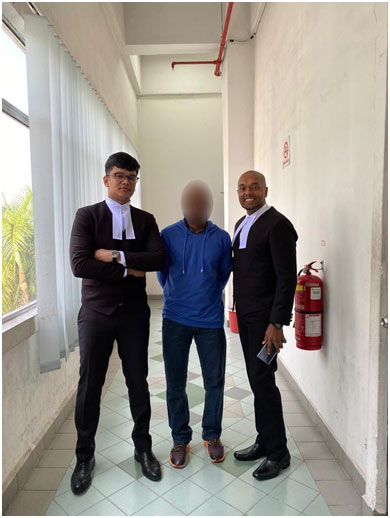
SHAH ALAM:
Helmets are most commonly associated as tools for safety, but in this case, a motorcycle helmet was the alleged murder weapon. Since 24 September 2018, the Shah Alam High Court heard a case against the now 37-year-old Saravanan a/l Renugopal on a charge of murder under Section 302 of the Penal Code. If convicted, the Accused faces the mandatory death penalty by hanging. The victim was Shaarunan a/l Ganesh, who was 19 years old at the time of the alleged incident.
After hearing the testimony of 16 Prosecution’s witnesses, at the end of Prosecution’s case, YA Dato’ Zulkifli bin Bakar held that the Prosecution had failed to prove a prima facie case against the Accused and ordered for his immediate acquittal.
It was the Prosecution’s case that on the night of 27 January 2017, the Accused and the victim’s cousin, Dineshwaar a/l Tamil Selvan, went to the Accused’s workshop to check on Dineshwaar’s bike.
Later that night, the Accused was seen arguing with the victim and allegedly hit the back of the victim’s head using a helmet, with the former accusing the latter of stealing some motorcycle batteries from his workshop.The victim and his cousin then left the workshop for home. When Dineshwaar arrived, he called the victim and was informed by the victim in a weak voice that he had a headache and was experiencing vertigo. Dineshwaar searched for the victim but came up empty handed. Later that day an eyewitness saw the victim squatting – and later lying down – by the roadside at Batu Caves next to his motorcycle. That night the eyewitness approached the victim and found that he had passed away.Thecause of death was declared to be “blunt force injury”.
The Learned Trial Judge in acquitting the Accused has decided that a prima facie case was not made out as evidences adduced by the Prosecution did not irresistiblypoint to the guilt of theAccused. Not only that there was absolutely no scientific evidence to link the Accused against the charge preferred against him, but also 2 of the Prosecution’s witnesses whom were present during the incident testified that they did not actually witness the act of Accused hitting the victim with helmet. The Prosecution’s case was further doubted when they failed to call 3 other eyewitnesses – 2 employees and 1 customer whom were also present at the workshop that nightto give evidence in Court; and that failure, would warrant an adverse inference to be drawn against the Prosecution.